Metrics Are Not Born Equal
Most investing tools throw dozens of ratios at you. Seasoned investors usually do the opposite: they come back to a smaller set of metrics that say something durable about quality, cash, discipline, and valuation.
The problem is not too little data. It is too little judgment.
Open almost any investor dashboard and you get buried in ratios: dozens of valuation multiples, niche leverage measures, technical statistics, adjusted figures, and one-off growth rates. The screen looks sophisticated. The decision quality often does not improve.
That is because metrics are not born equal. Some help you understand the economics of the business. Others mostly create motion and false precision. Experienced investors tend to care less about how many numbers a tool can show and more about whether the numbers answer a small set of important questions.
Is the business profitable in a durable way? Can it reinvest capital at high returns? Does accounting profit turn into real cash? Is growth valuable or just expensive? Are shareholders being diluted? And what does the current valuation already assume?
What seasoned investors keep coming back to
This is the cleanest test of business quality. In Berkshire Hathaway's acquisition criteria, Buffett explicitly asked for businesses earning good returns on equity while employing little or no debt. Terry Smith is even more explicit: his 2014 annual letter frames return on capital employed as one of the core measures of quality. If a company needs huge capital just to stand still, that usually shows up here.
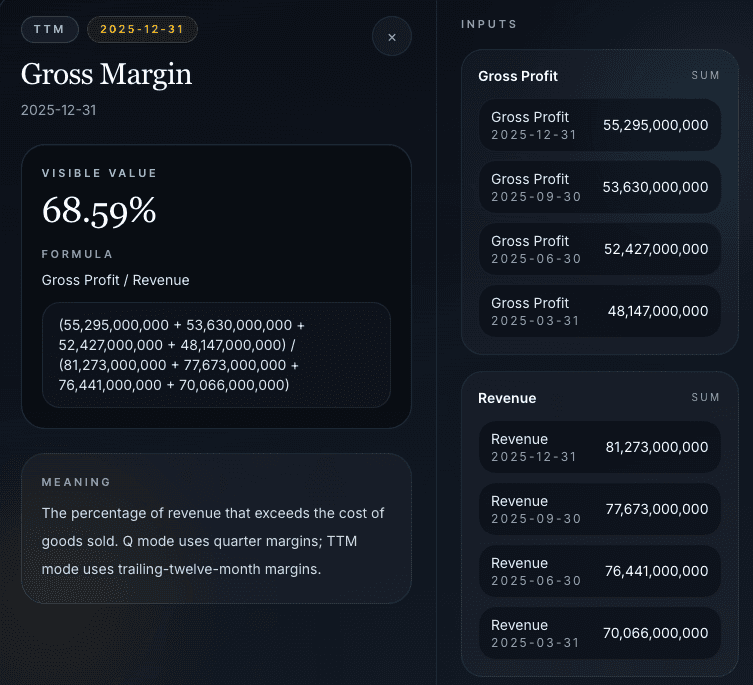
High and stable margins often signal pricing power, product value, and structural advantage. Fundsmith's letters repeatedly track gross margins and operating profit margins because they say something durable about the economic quality of the business, not just about this quarter's result.
Buffett made owner earnings famous because reported earnings alone can flatter a business. Terry Smith tracks cash conversion for the same reason. If free cash flow consistently lags reported profit, the economics are weaker than the income statement suggests.
Peter Lynch's famous rule of thumb was that a fairly priced company's P/E should roughly match its growth rate. The point is not that growth is always good. The point is that growth only matters when you compare it with valuation and with the underlying economics of the business.
Shareholders do not own the income statement. They own their share of the business. That is why share count and stock-based compensation matter. A company can grow earnings while reducing the value of each share. Seasoned investors watch dilution because it tells you who is actually capturing the economics.
Price-to-earnings, EV/EBIT, EV/EBITDA, and price-to-free-cash-flow are not interchangeable. The right multiple depends on what kind of business you are looking at and what distortions you are trying to avoid. The metric matters less than whether it maps sensibly to how the company actually makes money.
- Does the business earn high returns on capital?
- Are margins strong and durable?
- Does net income turn into free cash flow?
- Is growth valuable at this valuation?
- Are shareholders being diluted?
- Margins
- Growth
- Capital efficiency
- Cash-based valuation
- Dilution and robustness
Which metrics are less valuable in practice
This is where most tools overdo it. Not every metric deserves equal space on the page.
Revenue by itself is weak. Growth without margins, returns, or cash conversion can simply mean the company is buying growth at a bad price.
Adjusted EPS by itself is weak. Once stock-based compensation, restructuring, or acquisition costs are routinely added back, the metric often becomes more narrative than economics.
EBITDA by itself is often weak for capital-intensive businesses because it skips over real reinvestment needs. It can be useful, but only in context.
Price-to-sales by itself is weak. A high-margin software company and a low-margin distributor can have the same sales multiple and totally different economics.
Generic liquidity or balance-sheet ratios are often overused. They can matter in distressed or cyclical situations, but they are rarely the main driver of long-run compounding in a quality business.
Why our metrics tab is curated this way
DeepFundamental does not try to win by showing the longest possible metric list. The point is to surface a smaller set that maps to the real questions investors ask: quality, growth, valuation, cash, and dilution.
That is why the metrics tab is grouped around profitability, growth, cheapness, capital efficiency, dilution, and financial robustness. Those groups are not arbitrary. They reflect the metric families serious investors actually use to judge whether a business is worth more work.
A practical reading order
- 1.Start with margins and returns. If the business economics are weak, the rest matters less.
- 2.Check cash conversion. Make sure accounting profit actually becomes owner cash.
- 3.Look at growth only after quality. Fast growth in a weak business is not the same thing as valuable growth.
- 4.Check dilution and valuation last. Ask what you are paying and how much of the business each share still owns.
Open the metrics that actually matter
Skip the metric sprawl. Open a live ticker and work through a curated set of filing-backed metrics grouped around real investor questions.