What Is Reverse DCF?
A reverse DCF starts with the stock price, backs into the growth and margin assumptions implied by that price, and then asks the only question that matters: are those assumptions realistic?
Reverse DCF flips the question
A standard discounted cash flow model asks: what is this business worth if my assumptions are right?
A reverse DCF asks the opposite: given today's stock price, what assumptions about growth, margins, and cash generation must already be true?
That makes it immediately more practical for investors. The market has already given you a price. The useful job is not to build a beautiful spreadsheet detached from reality. It is to translate the current price into a plain-English expectation set and compare that expectation set with the actual business.
Start with your forecast
You choose revenue growth, margins, reinvestment, discount rate, and terminal value assumptions, then compute a fair value.
Start with the market price
You hold the price constant and solve backward for the growth or margin assumptions that the market is implicitly pricing in.
Why it is more practical than a full DCF
The hard part of valuation is not calculating present value. It is choosing assumptions that are not fantasy. A full DCF can create a false sense of precision because the spreadsheet looks rigorous even when the growth path is made up.
Reverse DCF is more practical because it starts from the one thing you do know: the price investors are paying right now. It forces you to confront the expectations already embedded in that price instead of hiding them inside your own model.
That is also why it is so useful as a first-pass valuation tool. If the current price already implies ten years of hypergrowth and major margin expansion, you can know that before building a full operating model. If the implied assumptions look modest, the stock may deserve deeper work.
What a reverse DCF actually solves for
The price is the anchor. Depending on the model, you convert share price into market cap or enterprise value.
You still need a discount rate, forecast horizon, reinvestment logic, and terminal assumption. Reverse DCF is not magic. It is just a different direction of travel through the same valuation engine.
Most often that unknown is revenue growth, but it can also be an operating margin path, free cash flow margin, or some combination of assumptions.
Once you know what the price requires, the analysis becomes more grounded. Can this company really grow that fast? Hold those margins? Reinvest at that rate? Outrun competition for that long?
The mental model
Think of reverse DCF as a decoder ring for the stock price.
The price itself does not tell you whether a stock is expensive. But the price plus the implied growth and margin assumptions can tell you what must happen for today's valuation to make sense.
That reframes valuation from “what is my target price?” to “what future is the market already betting on?”
Reverse DCF is not easier because it needs fewer assumptions
It is easier because it makes the argument cleaner. A normal DCF often ends in a fair value that looks precise but hides dozens of opinionated choices. A reverse DCF produces a sharper claim: “At this price, the market is assuming X.”
That claim is easier to debate. You can compare the implied expectation against the company's own history, industry structure, unit economics, customer concentration, reinvestment needs, and competitive realities.
If the stock requires heroic assumptions, you do not need false precision to say so. If the stock only requires reasonable execution, the market may be less demanding than the headline multiple suggests.
Where investors usually go wrong
- 1.Treating the output as certainty. Reverse DCF still depends on discount-rate and terminal-value assumptions. It is a framing tool, not a revelation from nature.
- 2.Solving for one variable while hiding unrealistic ones elsewhere. If you solve for growth but quietly assume very generous margins and capital efficiency, the answer can still be misleading.
- 3.Ignoring business quality. The point is not just to extract an implied growth rate. It is to compare that expectation with what the company can plausibly deliver.
Why this fits our product
Reverse DCF is only as good as the business inputs underneath it. If your revenue, margins, free cash flow, and share count are stale, standardized badly, or detached from the filing record, the implied expectations become fiction.
That is why this is such a strong fit for DeepFundamental. The goal is not just to show a valuation output. It is to connect that output to the actual operating reality in the company's filings and ask whether the market's implied assumptions are credible.
Use the calculator to turn price into a concrete expectation
The practical next step is not another paragraph about valuation. It is to run a live reverse DCF on a company you care about and see the implied growth rate directly.
DeepFundamental's reverse DCF calculator sits inside the analysis workflow, preloaded with live valuation multiples. That lets you go from price to implied expectations without leaving the product or rebuilding the setup in a spreadsheet.
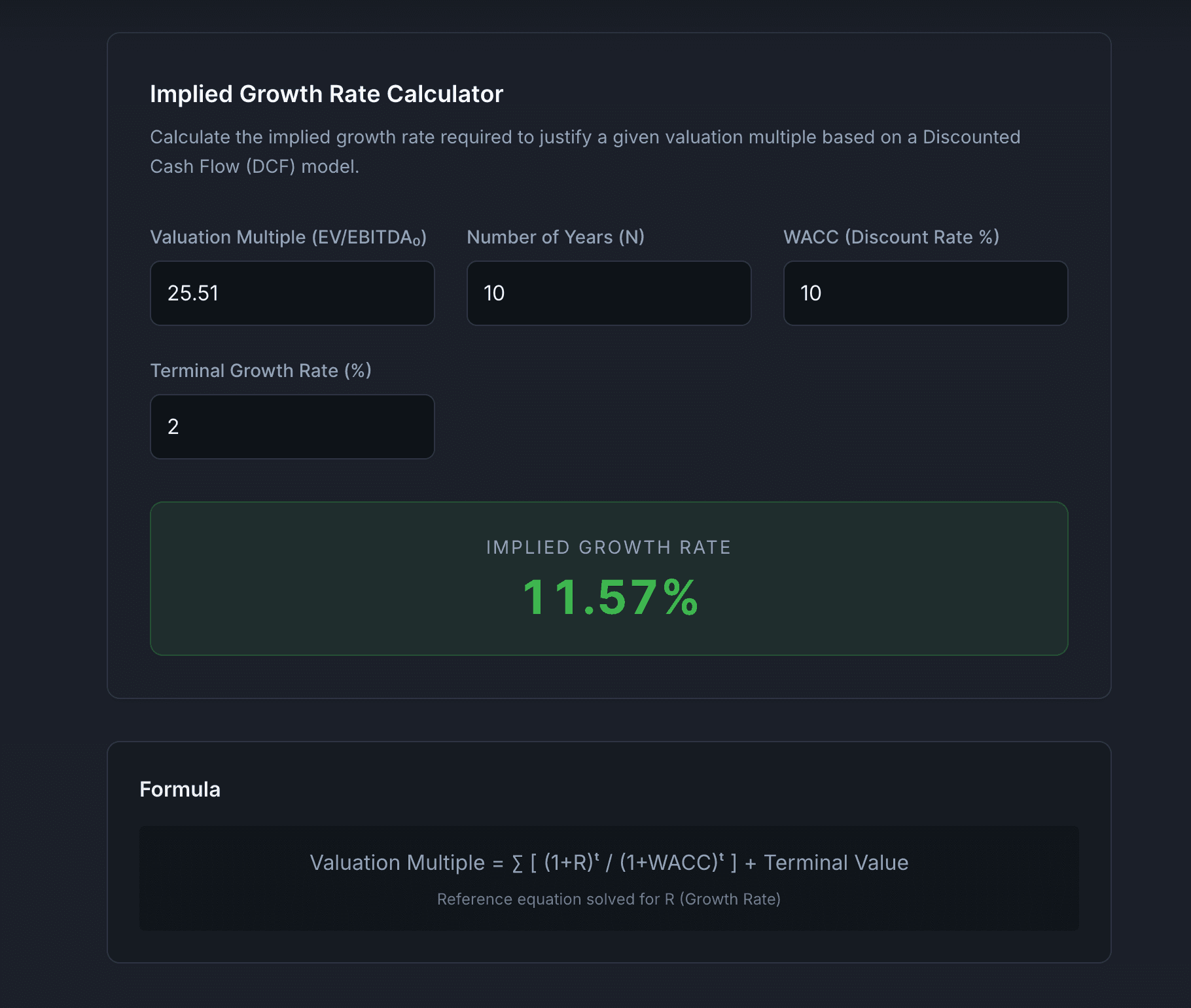
Start from the market multiple already attached to the stock.
Adjust years, discount rate, and terminal growth in seconds.
See the implied growth rate instantly instead of inferring it by hand.
Compare that implied expectation with the actual filing-backed business.
Open the reverse DCF calculator
Run the calculator on a live ticker, then compare the market's implied growth assumptions with the company's actual operating reality.